

Tuesday · November 10 “Every version of you got you here.”
Three Chains, One Decision
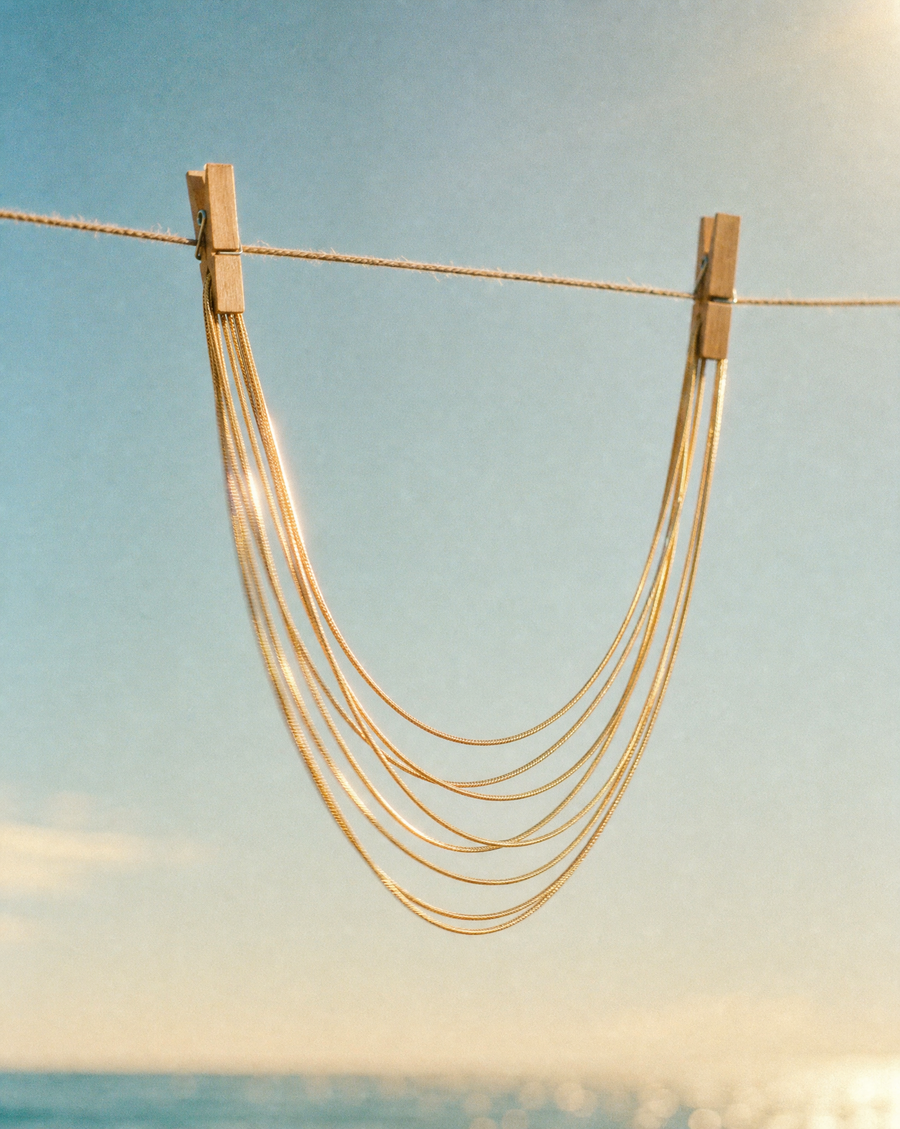
Layered gold-plated chains worn together at different lengths from Love Your Beauty
The necklaces you don't wear are rarely the ones you regret buying. They're usually the ones that came out of the drawer once, spent an afternoon knotting themselves around something else, and went straight back in.
That's a spacing problem, and it has very little to do with taste. Chains tangle when they sit at the same height, so giving each one at least five centimetres of its own room solves most of it before you've made a single decision about how it looks.
How do you layer necklaces without them tangling?
Two chains hung within a centimetre of each other spend the day crossing. Every turn of your head drags one across the other, friction does the rest, and by the evening they've braided themselves together while you were thinking about something else.
Separate them properly and they behave completely differently. A 40cm sits at the base of the throat, a 45cm on the collarbone, a 50cm below it, and because none of them wants the same inch of skin they move independently all day.
The bit nobody mentions: the chain itself
Length is most of the answer. How the chain is built is the rest, and it explains why two necklaces at perfectly good spacing can still misbehave.
A round-link chain rolls. It turns over on itself as you move, which is how the clasp ends up at your throat by mid-afternoon, and a rolling chain will always find a neighbour to catch on. A flat chain, herringbone or snake, lies down against the skin and stays where you put it.
So put the flat one closest to your neck and everything above it sits more calmly. It's also why a cheap-looking stack is usually three round chains of similar weight, with nothing in it holding the others steady.
How many is right?
Three reads as a decision. Two can look as though the second one was forgotten, and four starts asking to be adjusted through the day, which is how a necklace quietly becomes one you don't wear.
One is also a decision, by the way, and worth defending. There's a version of this advice that treats a single chain as a failure of nerve, and it's nothing of the sort.
If you want the look of more than three without managing it, buy it built. A multi-chain necklace comes pre-spaced and gathered at one clasp, so it can't tangle with itself, which removes the problem instead of teaching you to work around it.
The simplest place to start
 Twisted Harmony Necklace — £20.00 — Shop →
Interlocking circles on a single chain, which is to say it isn't a layered necklace at all. The depth is built into the piece, so there's nothing to space, nothing to realign at lunchtime, and nothing to untangle before bed.
Two tiers, decided for you
 Golden Hour Layers — £21.17 — Shop →
A flat herringbone with a finer chain beneath it, which is the construction principle doing exactly what it should. The herringbone lies flat and holds its position, so the lighter layer settles on top of it instead of fighting it all day.
The one that covers the whole neckline
 Golden Crescent Layer Set — £31.84 — Shop →
A crescent pendant with the spacing already sorted. This is the one to pick if you like the look and would rather not inherit the arrangement along with it.
The full version
 Golden Hour Layers Necklace — £50.35 — Shop →
Seven chains, pre-spaced, gathered at a single clasp. It's the fullest version of the idea with none of the daily negotiation, and it tends to be a piece women arrive at rather than start with.
What if the chains you own are all the same length?
Then you don't need to buy anything to fix it. An inexpensive extender adds five centimetres to whichever chain you want sitting lower, and it disappears under hair or a collar.
Failing that, fasten one chain a link or two short of its full length so the clasp sits forward of the nape. It shortens the chain by a useful amount, costs nothing, and nobody will ever see it.
Does the neckline change what works?
More than the necklaces do. A high neck wants length, because anything short disappears into the fabric and reads as a bump; an open collar gives you the whole throat to play with, which is where three lengths look best.
A round neckline defeats most stacks. The fabric already draws a curve, and a second curve sitting just above it competes with the first, so one longer chain falling below the neckline is usually the better answer.
Can you mix gold and silver?
You can, and the old rule against it was never about anything real; matching sets were simply easier to sell. What makes mixed metals read as deliberate is repetition, so silver at your neck and silver at your ear is legible as a choice.
A single silver chain among gold is the one that looks accidental. If you're layering in silver, the sterling silver pieces will give you that repetition.
How do you keep them ready to wear?
Fasten every clasp before you put it down. An open chain is a hook looking for something to catch; a closed loop isn't, and that one habit prevents most of the knots you'd otherwise spend an evening undoing.
Then hang them instead of piling them. Chains settle into each other overnight under their own weight, patiently and thoroughly, and a row of small hooks will outperform any box with velvet compartments.
The full layered necklaces edit is here, and if you'd rather understand the metals before committing to anything, start with what jewellery is actually made of.
Three lengths, one clasp each, and a flat chain at the bottom of the stack. That's the whole of it, and like everything at Love Your Beauty it's meant to be worn because it's yours rather than saved for an occasion that may or may not turn up.
Common questions
How far apart should layered necklaces be?
At least five centimetres between each chain. A 40cm, 45cm and 50cm combination gives every layer its own ground to sit on, whereas chains hung within a centimetre of each other will cross and tangle all day.
Why do my necklaces still tangle when the lengths are different?
Because of how the chains are built rather than how long they are. A round-link chain rolls over on itself as you move and catches whatever's beside it, so putting a flat chain such as a herringbone closest to your neck steadies the whole stack.
How many necklaces should you layer at once?
Three reads as a decision, and one worn alone is just as deliberate when it's the piece you want. Four starts needing adjustment through the day, which is the quickest route to not wearing it at all.
Can you mix gold and silver necklaces?
You can. The trick is repetition rather than restraint, so silver at your neck and silver at your ear reads as a choice, while one lone silver chain among gold just looks accidental.
How do you keep necklaces from tangling in storage?
Fasten every clasp before putting it away, then hang the chains instead of piling them. An open chain is a hook looking for something to catch, and a pile settles into itself overnight under its own weight.
Wear it
Twisted Harmony Necklace — £20.00 — Shop →
Golden Hour Layers — £21.17 — Shop →
Golden Crescent Layer Set — £31.84 — Shop →
Golden Hour Layers Necklace — £50.35 — Shop →
Arrow keys, or swipe


One letter, most Sundays.
Written to one woman rather than a list. No offers dressed as observations, and nothing sent because it is a Tuesday.