

Friday · October 23 “Write the chapter only you could write.”
Soft Power
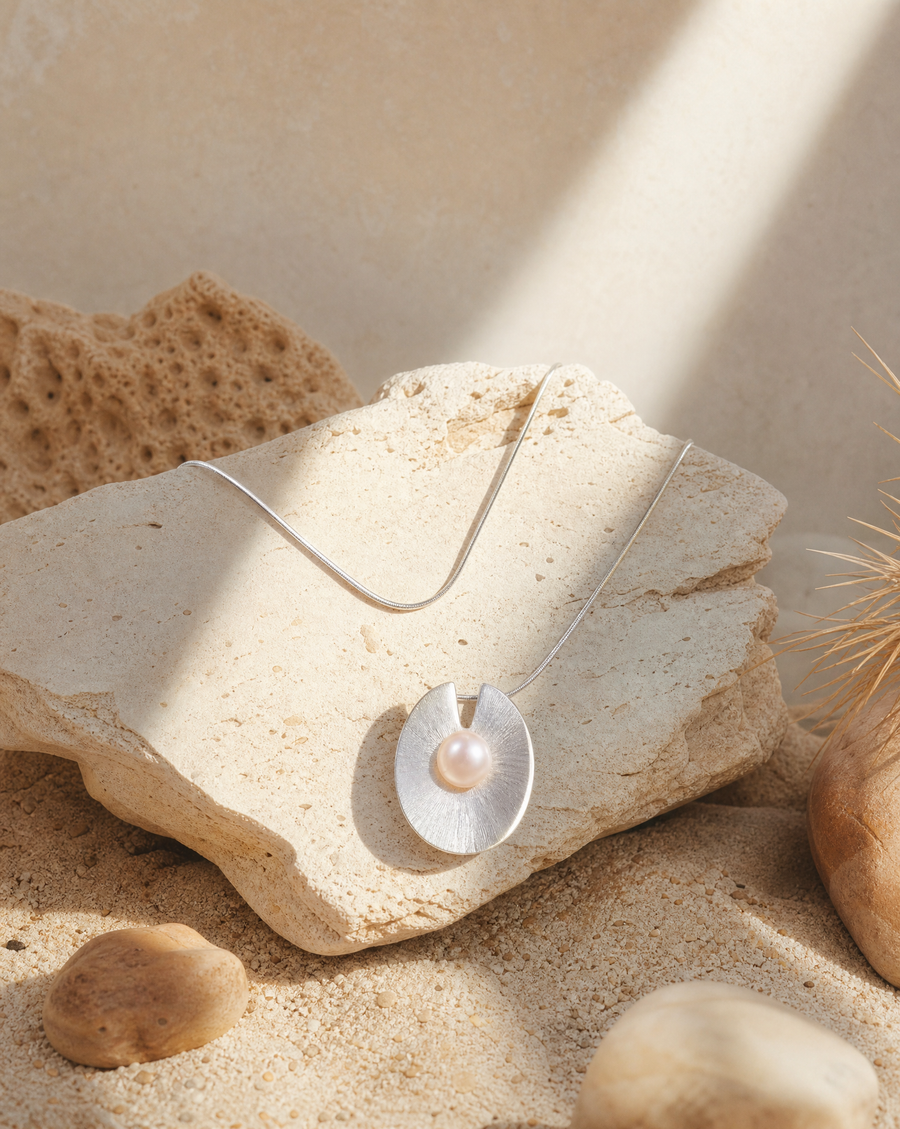
Sterling silver pearl pendant necklace from the Soft Power collection at Love Your Beauty
You have got very good at the part where you cope. What you have lost is the part where anything feels like yours — the hour that is not owed to someone, the evening that is not preparation for tomorrow.
How do you slow down when life is genuinely full?
By protecting something small and non-negotiable rather than waiting for a gap to appear. Twenty minutes that belong to nobody else, defended as firmly as you would defend a meeting, does more than an occasional whole day off.
The gap never appears on its own. That is not a failure of organisation — it is arithmetic.
Why doesn't self-care work?
Because most of what is sold under that name is a break from your life rather than a change to it. A bath, a candle, a Sunday — pleasant, and gone by Monday morning.
Nothing wrong with a bath. It is just that a break restores you to the same conditions, so it has to be repeated indefinitely to do anything at all.
What changes things is a smaller thing done regularly, in the middle of the ordinary week rather than at the end of a bad one.
What is Soft Power?
The chapter at Love Your Beauty for the woman who is settled rather than striving. Calm over hustle, sovereign rather than busy — and none of it performed.
The Soft Power collection holds the quieter half of the range: loungewear, sunglasses, the pieces that work when nobody is being impressed.
Where to start
Cultivating calm in the middle of chaos is the one to read first, because it assumes the chaos is not going anywhere.
The case for me-time is for anyone who needs the argument before they will take the twenty minutes.
What does a ritual actually do?
It removes the decision. That is the mechanism, and it is a duller answer than most people want.
Anything you have to choose to do competes with everything else you could be doing, and on a full day it loses. Anything you simply do at a particular time does not have to win that argument.
Which is why the specific ritual matters far less than its regularity. Lighting a candle at seven is not meaningful in itself; doing it every evening is.
Building one
Rituals that build self-esteem and daily practices are the practical pair.
Self-care aligned with your values is the one that separates what actually restores you from what you have been told should.
For the evening version, making a calm space with candles and candles for meditation. Calming activities is the broader list.
And from the archive, the art of finding headspace, which has aged well.
What has any of this to do with sunglasses?
More than it sounds. Soft power is about not being constantly available for inspection — and there are objects that genuinely help with that.
A good frame changes how you hold your face before you have said anything. Sunglasses and rediscovering yourself takes that seriously; what a frame does to a look is the lighter read.
The whole of it
Calm is not something you arrive at once the list is finished. The list is never finished, and organising your life around that day is how the years go.
It is a set of small defended habits inside an ordinary week. Less impressive than a retreat, and it survives contact with a Tuesday.
Start with twenty minutes. Defend them badly at first. Keep going.
Common questions
How do you slow down when you genuinely have no time?
Protect something small and fixed rather than waiting for a free afternoon. Twenty defended minutes at the same time each day is more achievable, and more effective, than an occasional whole day that never quite happens.
Why doesn't self-care make me feel better?
Often because it is a break from your circumstances rather than a change to them. A bath restores you to the same conditions, so it has to be repeated forever; a small regular habit shifts the baseline instead.
What makes a ritual different from a routine?
Mostly that a ritual has your attention in it. The practical value of both is the same though — they remove the daily decision, which is what stops the thing losing out to everything else you could be doing.
What does the Soft Power chapter mean?
It is Love Your Beauty's chapter for being settled rather than striving — calm over hustle, and the quieter pieces and writing that go with it.
How long does it take for a new habit to stick?
Longer than most articles promise and less than you fear. What matters far more than the number of days is whether the thing happens at a fixed time, because that is what stops it competing with everything else.
Arrow keys, or swipe
Questions
How do you slow down when you genuinely have no time?
Why doesn't self-care make me feel better?
What makes a ritual different from a routine?
What does the Soft Power chapter mean?
How long does it take for a new habit to stick?



One letter, most Sundays.
Written to one woman rather than a list. No offers dressed as observations, and nothing sent because it is a Tuesday.